
The Waterproof Parcel
Some thoughts on ignorance
Prologue
I posted this eponymous piece on my blog back in August of 2018. More than seven years later, I reckon this brief essay is still relevant and useful. A big reason why I write essays is to converse with my older self in a calm, patient, and empathetic manner. So I typically read my own essays—both here on Substack and on my separate blog—once in a blue moon to jog my memory and cross paths with my younger self. In fact, there’s a blood moon in the night sky as I write this sentence during a lunar eclipse on the 3rd of March, 2026. I wanted to include this old essay in my Substack collection because I believe it fits snugly among my other essays here, which focus on physics, philosophy, and poetry in meaningful ways for my separate selves at the present or in the future. And it might make reading just a little bit more convenient for my ageing soul, when the Earth and the Moon shall cross paths again.
Angel Wings on a Box
In the film Cast Away (2000), there’s a poignant scene where Chuck (played by Tom Hanks) is lying on his floating raft, emaciated and barely conscious, accompanied by his lifeless friend Wilson. Slowly, Wilson becomes untethered and begins to drift away. When Chuck realises this he desperately tries to retrieve Wilson, but returns to the raft empty-handed after almost drowning in the process. Wilson keeps ebbing and flowing with each undulating ocean ripple, beyond the reach of a distraught Chuck, just as any volleyball would in such a circumstance.
Near the end of the film, Chuck returns the unopened box that he had been protecting all along, even at the expense of Wilson. The journey of that box is what I think of as the waterproof parcel. It’s an image that invites one to dream up many possibilities, if only then to ignore them all, before settling on the magical assumption that a parcel will travel across oceans with its exact route being irrelevant, so long as it reaches its destination, or returns to its sender, undamaged, and unopened.
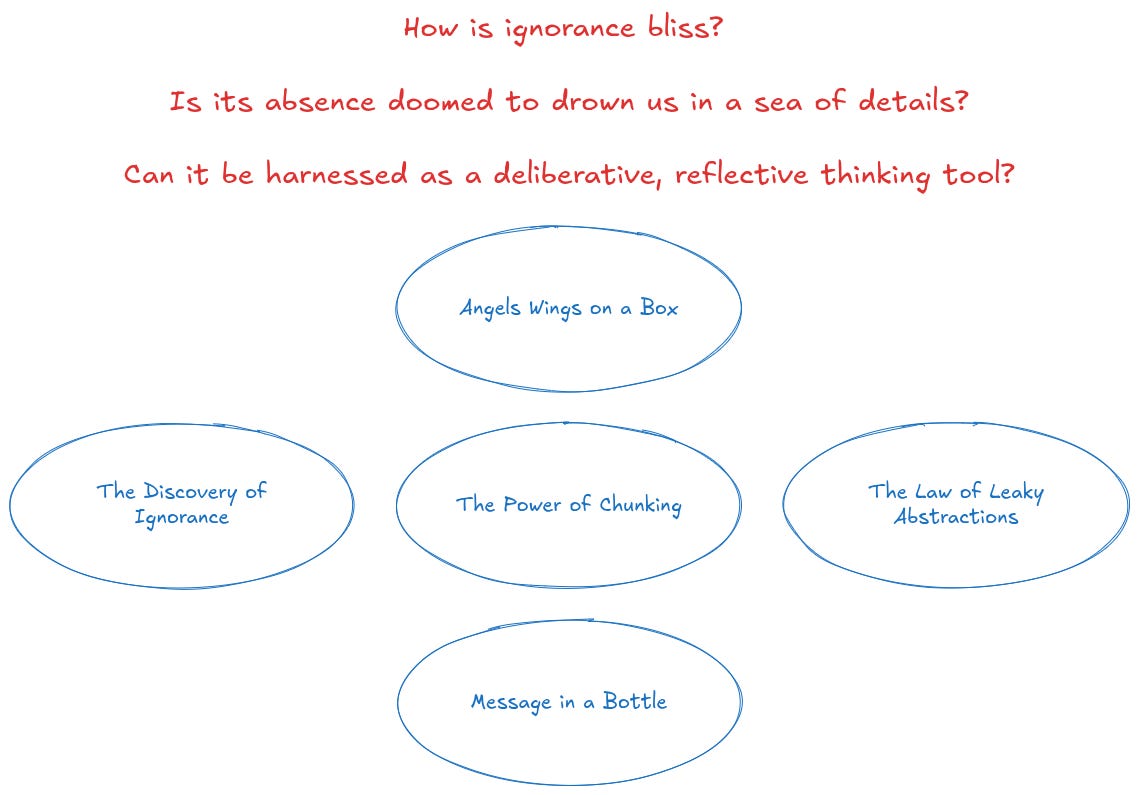
The threats of reality are somehow vanquished by stencilling angel wings on a box, if Cast Away is to be taken literally. Even figuratively speaking, ignoring reality is both marvellous and flawed. The crossroads of these forces fascinates me endlessly, much as Chuck is rhetorically left standing at one in the end. How is ignorance bliss? Is its absence doomed to drown us in a sea of details? Can it be harnessed as a deliberative, reflective thinking tool?
The Discovery of Ignorance
It’s very likely that our distant ancestors did not know the conscious feeling of not knowing. In other words, ignorance is something that needed to be discovered, defined, and disseminated, as pointed out by Yuval Noah Harari in his book Sapiens (2011). “The Scientific Revolution,” wrote Harari, “has not been a revolution of knowledge. It has been above all a revolution of ignorance. The great discovery that launched the Scientific Revolution was the discovery that humans do not know the answers to their most important questions.”
I wrote about the clarity of doubt previously. It seems to me that doubt is the antecedent of ignorance, and probably led to “the discovery of ignorance” in the conscious sense that Harari meant it. After all, the unconscious ignoramus within each of us remains buried until unearthed by doubt. Thus, we usually do not know that we do not know. Of course such ignorance can easily be brought to the foreground of our attention from the outside, e.g. by reading. Hence doubt, among others, is an introspective tool when it comes to realising that we do not know something, e.g. answer to a question raised by doubt. This realisation, I think, fosters the sort of conscious ignorance that leads to pondering, observing, theorising, experimenting, and falsifying in our modern scientific quest for knowledge.
The Power of Chunking
The buried, veiled, unrealised, or unconscious ignorance is not all bad for us though. The message from psychology is that humans have an almost unlimited ability for chunking, which is the unconscious process of lumping or grouping things into larger things, and then only dealing with those larger things in turn. It underlies our short-term memory and our endless ability to learn new motor skills. When confronted with many pieces of information, our brains chunk them into similar sets in a hierarchical manner, and repeat the process at each level of the hierarchy such that any granularity is lost within each chunk. It’s the kind of ignorance that’s hardwired into us, blissfully. Natural selection has shaped our brains so that we won’t drown in details when matters of survival are at stake.
The Law of Leaky Abstractions
The unconscious realm of chunking can be extended into the conscious realm of abstractions. Given our propensity for ignoring the grains within a chunk, it’s easy to create stacked levels of abstractions where more details appear as you traverse from high to low levels. Nowhere is this more widespread, and better understood, than software development. The entire practice of writing code is an exercise in deliberate ignorance, which is what abstracting really is. In fact, abstracting is a fine art in the land of software development, where notions of beauty and elegance are directly associated with ignoring the right amount of detail. Think of your favourite Impressionist painting for an analogy.
However, the great flaw in abstractions is pointed out by Joel Spolsky in what he calls “the Law of Leaky Abstractions,” which states that “All non-trivial abstractions, to some degree, are leaky.” Spolsky goes on to further elaborate: “Abstractions fail. Sometimes a little, sometimes a lot. There’s leakage. Things go wrong. It happens all over the place when you have abstractions.” Put another way, ignoring details can only sail so far. Sooner or later we pay the price of operating at a high level of abstraction, because reality from the lower level inevitably leaks through and sinks our boat. The waterproof parcel becomes soaking wet, eventually.
Message in a Bottle
This eponymous song by The Police tells the story of “Just a castaway” realising that there’s “A hundred billion castaways” out there. I think it captures the marvels and flaws of ignorance succinctly, as does the film Cast Away. There’s a conscious and an unconscious dimension to ignorance. We don’t always realise that we don’t know something, which tends to restrict our imagination. Doubt sets us free to wonder, and to question. Science puts us in touch with reality. When reality becomes overwhelming—we chunk, and we abstract. Then, just when we’re blissfully sailing along, reality springs a leak. Ultimately, nothing is waterproof. Everything gets wet. Even this message in a bottle.
Epilogue
Thinking back to the ending of Cast Away, where Chuck stands at a crossroads, I’m reminded of a poem by Robert Frost called The Road Not Taken (1915). Frost seemingly wrote the poem as a joke for his friend Edward Thomas, who was often indecisive when encountering a fork in the road while out walking in the wood with Frost. But Frost also purportedly said: “I’m never more serious than when joking.” So it feels apt to append his words in this new ending of an old essay:
Two roads diverged in a yellow wood,
And sorry I could not travel both
And be one traveler, long I stood
And looked down one as far as I could
To where it bent in the undergrowth;
Then took the other, as just as fair,
And having perhaps the better claim,
Because it was grassy and wanted wear;
Though as for that the passing there
Had worn them really about the same,
And both that morning equally lay
In leaves no step had trodden black.
Oh, I kept the first for another day!
Yet knowing how way leads on to way,
I doubted if I should ever come back.
I shall be telling this with a sigh
Somewhere ages and ages hence:
Two roads diverged in a wood, and I—
I took the one less traveled by,
And that has made all the difference.