
The Problematic Y
Robust intuition pump for patient thinking
Prologue
I’m bringing over to Substack another brief essay from my separate blog. I posted this way back in July of 2018. Reading it again reminded me to thank my younger self, who sagely sensed something sane in this “punny” piece. Besides, it complements all my other essays nicely.
Thinking Is Not Fun
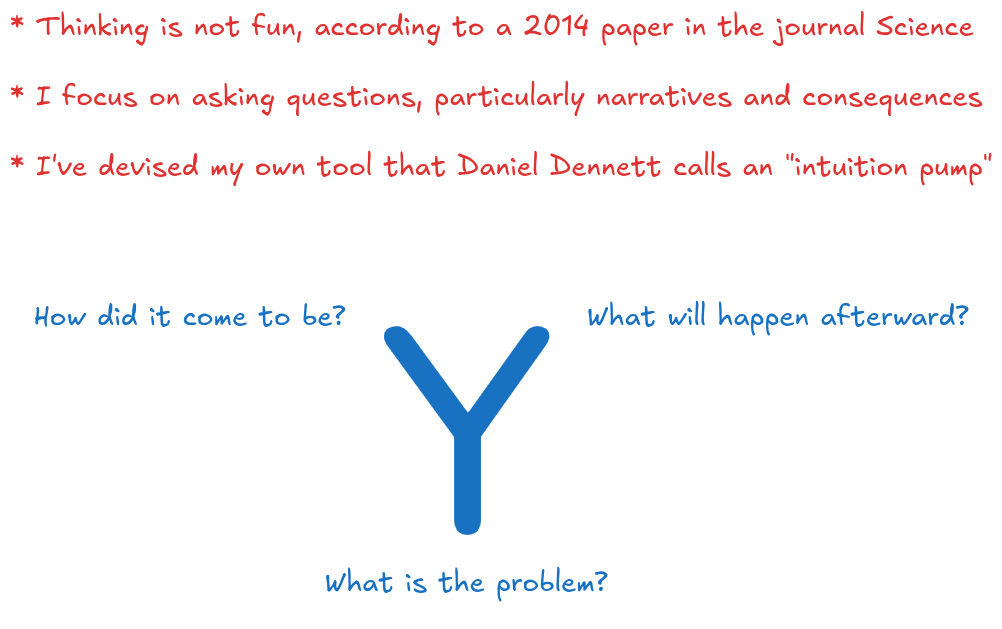
I recently stumbled on a 2014 paper in the journal Science, titled “Just think: The challenges of the disengaged mind.” Apparently people do not enjoy the act of simply thinking consciously for the sake of thinking. Instead, they prefer to be doing something mundane, or even shocking (quite literally). Certainly surprised me, because I love to just think and do nothing! However, I know from past experience that consciously thinking about a problem is definitely not fun. I seem to have a penchant for thinking about solutions without exploring in detail what the problem is. So to help me overcome that urge, over the years I’ve relied on a thinking tool that I call The Problematic Y.
The Right Questions
It’s generally accepted that asking the right questions is far more important than finding the relevant answers. Over time, only the questions tend to endure while any set of answers typically get revised heavily (if not discarded entirely). I’ve found that it helps to periodically remind myself about two key questions:
What is the problem?
Why is it important?
The first is obvious enough. The second, however, runs into the infinite regress issue of any “why” question. In other words, it’s always a subjective debate when justifying the importance of a problem. That never excites me. I absolutely hate the prospect of justifying to others a problem that somehow ignited my curiosity. Fortunately, I’ve learnt from reading Daniel Dennett’s wonderful books that the “why” question above is actually two separate questions in disguise as follows.
How did it come to be a problem?
What will happen after solving it?
The first is about the past, and is asking for narratives. The second is about the future, and is asking for consequences. Both are valid regardless of any given solution to a problem. So the importance of a problem can be justified in terms of past narratives and future consequences. All other details in that justification effort really fall into these two categories. Thus my initial two questions are actually better remembered as three questions, which I’ve illustrated below in the image of an uppercase Y.
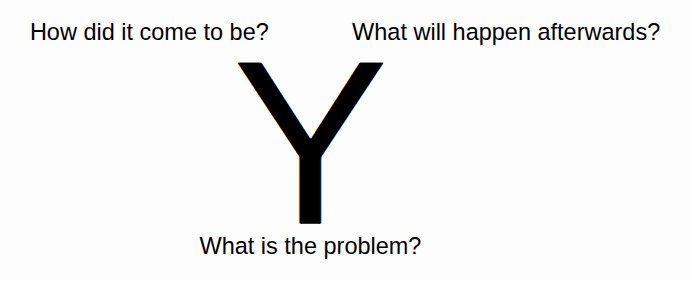
Short labels for these questions are narratives (left branch of the Y), definition (trunk of the Y) and consequences (right branch of the Y). You can read this diagram from left to right. The three questions are framed correspondingly in the past, present and future tenses to aid comprehension. There’s not a lot to be said about definition other than that it needs to be short and sharp. The challenges lie in pondering narratives and consequences.
Narratives
The plural here is noteworthy. There are always many narratives, never only one, when justifying a problem. I like to think of this as a multidimensional hypercube where each dimension is a narrative, and thus the position of a problem in this hyperspace necessarily comprises coordinate narratives.
What follows is my shortlist of dimensions to think about, which is obviously incomplete. I find that such pondering tends to highlight the essential constraints of a problem that, ultimately, a good solution must satisfy.
History
This is about the novelty and prevalence of a problem. Is it new or old? How often does it rear its ugly head? How long has it existed? If it’s a long-standing problem, how come it’s still unsolved? How much has this problem cost people (i.e. use a suitable measure of cost, not just money)?
Psychology
Whose problem is it? Is it a need (which is compulsory) or a want (which is optional)? Do people recognise it as a problem or are they unaware of its existence? Have people habituated to it to such an extent that it’s no longer worth solving?
Philosophy
This is largely a concern with epistemology. What assumptions are implicit in the problem definition? What happens if you remove an assumption? Is it still a problem in that case? Does it worsen? Is it an ethical dilemma?
Consequences
It’s a straightforward expectation that solving a problem will have many consequences. We’re all familiar with the phenomenon of unintended consequences. It’s not easy to predict all the effects of our actions, but it helps to extrapolate from the narratives figured out earlier, assuming that the problem has been solved. Furthermore, Neil Postman pointed out two questions as far as consequences are concerned.
What new problems might be created afterwards?
Who might be harmed and who might be empowered?
Regardless of the narratives of a problem, addressing Postman’s two questions above are instantly beneficial, because they hint at the two most frequent sources of unintended consequences. The wonderful book by Daniel Kahneman called Thinking, Fast and Slow (2011) pointed out a particularly pernicious consequence of change that leads to losers and winners: losers always resist such changes vehemently because the pain of losing is a stronger emotion than the converse joy of winning. This is the insight behind Postman’s second question above.
More broadly, thinking about consequences of any given problem has typically led me to consider risk and reward in a new light. That’s how I came to love Kahneman’s book. In addition, Nassim N. Taleb has written some thought provoking books on these topics. The key lesson I’ve taken away from Taleb’s writing is the wisdom of restricting losses and unrestricting gains. That is, regardless of the risk that may be inherent in a problem, the correct action is to focus on manipulating the gains and losses, rather than the probability. Taleb calls it fixing the exposure and not the probability, because we cannot estimate probabilities accurately for rare events. So control your exposure in all the ways you can (e.g. insurance, contracts), and ignore probabilities.
An Intuition Pump
Daniel Dennett coined the clever term intuition pump, which refers to a thought experiment or a thinking tool that helps to see the main points of a problem. I strongly recommend his book Intuition Pumps and Other Tools For Thinking (2013). What I’ve learned from that book (and other books by Dennett) is that it is indeed possible to think clearly, with a little effort, even if it’s not fun (as the Science paper at the start of this post made clear). Hence The Problematic Y has been a thoroughly helpful intuition pump for me.
Epilogue
I went back to Dennett’s book to remind myself of a number of thinking tools that are essential for making sense of the warring world we inhabit in 2026. One passage in the introduction emphasises for me again the lasting benefits of philosophy:
Like all artisans, a blacksmith needs tools, but—according to an old (indeed almost extinct) observation—blacksmiths are unique in that they make their own tools. Carpenters don’t make their saws and hammers, tailors don’t make their scissors and needles, and plumbers don’t make their wrenches, but blacksmiths can make their hammers, tongs, anvils, and chisels out of their raw material, iron. What about thinking tools? Who makes them? And what are they made of? Philosophers have made some of the best of them—out of nothing but ideas, useful structures of information.
Indeed, we can all make tools out of our ideas—if only we practice the patient craft of thinking.