
Reading Our Writing
What we talk about when we talk about reading
Prologue
What do we mean by reading? In the simplest sense, we’ve been reading what we’ve been writing for about six thousand years. And yet, we read more than the written word. We read faces. We read the room, filled with voices and silences. We read paintings, hung on museum walls and palmed on ancient rocks. We read a landscape we can control and the starry night we cannot conquer. We even read between the lines. And nobody seems to read the written word in exactly the same way. Thus, in an extreme sense, we read anything invisible and we read everything inanimate. But the question stubbornly remains: what is reading? Or better yet: what are readings?
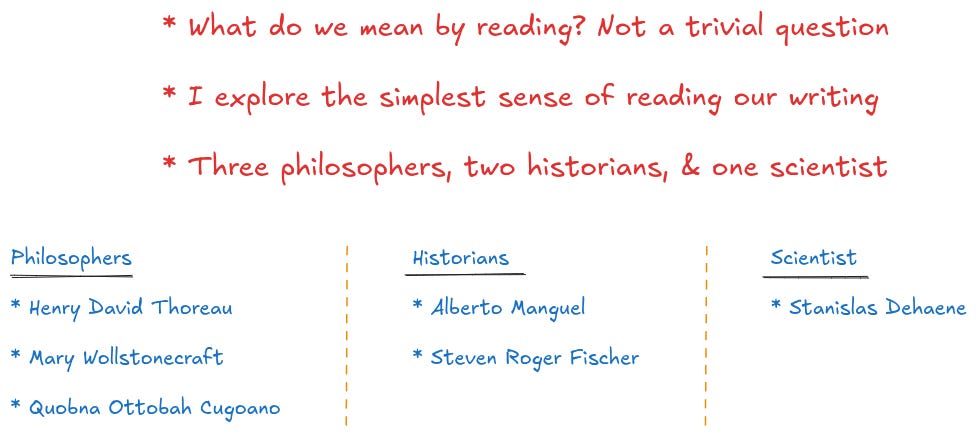
In this essay, I’ll explore only the simplest sense: reading what we’ve been writing. I’m naturally constrained when writing to highlight six astute thinkers out of so many. But I hope to explore the plural readings in future essays, since there are several brilliant thinkers who have expanded our understanding of the multiple meanings. And out of those who have studied the simplest sense over the millennia, my sample here includes three philosophers, two historians, and one scientist. Despite some categorical gaps in the sample, it still forms a secure platform that lets us board this train of thought about reading our writing.
Three Philosophers
Philosophy lets us figure out the right questions first. Whatever the answers turn out to be, asking the wrong questions is guaranteed to fail. So in digging deeper into the meaning of reading, I’m especially curious about how philosophers have studied the act of reading over the centuries. It’s the how questions that are important. How do we choose what to read? How do we interpret what we read? And crucially: how should we read?
There’s a technical sub-field in academic philosophy called hermeneutics, which investigates such questions about reading and interpreting the written word. It’s a rather deep rabbit hole for a novice. But I found The Blackwell Companion to Hermeneutics (2016) very informative. It’s edited by Niall Keane and Chris Lawn, whose introduction to the volume is written in an accessible style to clarify contemporary hermeneutics. This handbook is a suitable reference for the diligent student.
However, I’m inquisitively drawn to an outsider’s perspective, which tends to expose cracks in the received opinion. The three philosophers highlighted below were all outsiders in their times and in their places. They survived long enough to publish their insights about reading for the benefit of posterity. But it’s not their biographies that I discuss, only their ideas. I encourage you to separately research their incredible lives if you don’t know them. They are a constant source of inspiration for me. And their ageless ideas are priceless for us in the 21st century.
Henry David Thoreau
Thoreau published Walden; or, Life in the Woods (shortened as Walden) in 1854. I pull it down from my bookshelf and read aloud the opening paragraph whenever I need to tune my ears for the pursuit of rolling rhythm and perfect punctuation:
When I wrote the following pages, or rather the bulk of them, I lived alone, in the woods, a mile from any neighbor, in a house which I had built myself, on the shore of Walden Pond, in Concord, Massachusetts, and earned my living by the labor of my hands only. I lived there two years and two months. At present I am a sojourner in civilized life again.
Walden is rightly celebrated for Thoreau’s distinct voice and vision. What I find most insightful is his entire chapter titled “Reading.” He built his cabin to suit his habit of reading, for he tells us: “My residence was more favorable, not only to thought, but to serious reading, than a university; and though I was beyond the range of the ordinary circulating library, I had more than ever come within the influence of those books which circulate round the world, whose sentences were first written on bark, and are now merely copied from time to time on to linen paper.” In that thoughtful solitude of the New England woods, he valued the classic books from all over the world:
How many a man has dated a new era in his life from the reading of a book. The book exists for us perchance which will explain our miracles and reveal new ones. The at present unutterable things we may find somewhere uttered. These same questions that disturb and puzzle and confound us have in their turn occurred to all the wise men; not one has been omitted; and each has answered them, according to his ability, by his words and his life.
We all need Thoreau’s reminder that our disturbing and puzzling and confounding issues are actually ancient. Reading, then, is an act of rediscovery so that we can claim our inherited wisdom to make sense of the present. But it requires patient effort and focus, as he instructs:
To read well, that is, to read true books in a true spirit, is a noble exercise, and one that will task the reader more than any exercise which the customs of the day esteem. It requires a training such as the athletes underwent, the steady intention almost of the whole life to this object. Books must be read as deliberately and reservedly as they were written.
We catch a glimpse of his sense of aesthetics regarding the written word:
A written word is the choicest of relics. It is something at once more intimate with us and more universal than any other work of art. It is the work of art nearest to life itself. It may be translated into every language, and not only be read but actually breathed from all human lips;—not be represented on canvas or in marble only, but be carved out of the breath of life itself. The symbol of an ancient man’s thought becomes a modern man’s speech.
Ancient thought becoming modern speech is a vivid way to define reading. The time and space separating a reader from a writer is a common theme among all philosophers who have investigated the act of reading. Thoreau provides a clear contrast between the orator and the writer, which also delineates the reader:
However much we may admire the orator’s occasional bursts of eloquence, the noblest written words are commonly as far behind or above the fleeting spoken language as the firmament with its stars is behind the clouds. There are the stars, and they who can may read them. The astronomers forever comment on and observe them. They are not exhalations like our daily colloquies and vaporous breath. What is called eloquence in the forum is commonly found to be rhetoric in the study. The orator yields to the inspiration of a transient occasion, and speaks to the mob before him, to those who can hear him; but the writer, whose more equable life is his occasion, and who would be distracted by the event and the crowd which inspire the orator, speaks to the intellect and heart of mankind, to all in any age who can understand him.
Hence it’s the reader who extracts understanding from the written word. And it’s the reader to whom books are bequeathed as “the treasured wealth of the world and the fit inheritance of generations and nations.”
Mary Wollstonecraft
Wollstonecraft is known for the trailblazing book A Vindication of the Rights of Women (1792). She argued for the education of women on equal terms with men. She also published an earlier book titled Thoughts on the Education of Daughters (1787), which has a whole chapter dedicated to “Reading.” She emphasised critical thinking and prudent reading in a society that was still largely illiterate during the late 18th century:
It is an old, but a very true observation, that the human mind must ever be employed. A relish for reading, or any of the fine arts, should be cultivated very early in life; and those who reflect can tell, of what importance it is for the mind to have some resource in itself, and not to be entirely dependant on the senses for employment and amusement. …
Reading is the most rational employment, if people seek food for the understanding, and do not read merely to remember words; or with a view to quote celebrated authors, and retail sentiments they do not understand or feel. Judicious books enlarge the mind and improve the heart, though some, by them, “are made coxcombs whom nature meant for fools.” [A. Pope]
Those productions which give a wrong account of the human passions, and the various accidents of life, ought not to be read before the judgment is formed, or at least exercised. Such accounts are one great cause of the affectation of young women. Sensibility is described and praised, and the effects of it represented in a way so different from nature, that those who imitate it must make themselves very ridiculous. A false taste is acquired, and sensible books appear dull and insipid after those superficial performances, which obtain their full end if they can keep the mind in a continual ferment. Gallantry is made the only interesting subject with the novelist; reading, therefore, will often co-operate to make his fair admirers insignificant.
Wollstonecraft’s writing has a lasting wit that goes a long way toward cementing her literary legacy. Her sentiment on novelists of that time is equally applicable to celebrities of our time. She also coined some memorable maxims, for example: “Taste and thought open many sources of pleasure, which do not depend on fortune.” And ponder this: “In the school of adversity we learn knowledge as well as virtue; yet we lament our hard fate, dwell on our disappointments, and never consider that our own wayward minds, and inconsistent hearts, require these needful correctives. Medicines are not sent to persons in health.” A collection of her notes titled Hints was published posthumously in 1798, and contained her prescient remark about averting confirmation bias while reading:
When we read a book which supports our favourite opinions, how eagerly do we suck in the doctrines, and suffer our minds placidly to reflect the images which illustrate the tenets we have embraced? We indolently or quietly acquiesce in the conclusion, and our spirit animates and connects the various subjects. But, on the contrary, when we peruse a skilful writer, who does not coincide in opinion with us, how is the mind on the watch to detect fallacy? And this coolness often prevents our being carried away by a stream of eloquence, which the prejudiced mind terms declamation — a pomp of words. — We never allow ourselves to be warmed; and, after contending with the writer, are more confirmed in our own opinion, as much perhaps from a spirit of contradiction as from reason. — Such is the strength of man!
She lived during the Age of Enlightenment, but her thoughts harboured hallmarks from the Age of Romanticism that peaked decades after her death. She glorified the beauty and power of poetry long before Keats and Shelley. Wollstonecraft anticipated their passionate resistance to reason. And she was well ahead of her time, as evident in this passage from Hints:
I am more and more convinced, that poetry is the first effervescence of the imagination, and the forerunner of civilization. … The flights of the imagination, and the laboured deductions of reason, appear almost incompatible. Poetry certainly flourishes most in the first rude state of society. The passions speak most eloquently, when they are not shackled by reason. … Individuality is ever conspicuous in those enthusiastic flights of fancy, in which reason is left behind, without being lost sight of. … It is the individual manner of seeing and feeling, pourtrayed by a strong imagination in bold images that have struck the senses, which creates all the charms of poetry. A great reader is always quoting the description of another’s emotions; a strong imagination delights to paint its own. A writer of genius makes us feel; an inferior author reason.
Notwithstanding her sentiment regarding writers, there will be a false dichotomy if we infer that reading requires us to feel with the heart rather than reason with the head. We must not fault one to favour the other. Instead, we can adopt a union of Enlightenment and Romanticism so that we are free to use our heads and our hearts when reading.
Quobna Ottobah Cugoano
Cugoano published Thoughts and Sentiments on the Evil of Slavery in 1787. He begins the book’s ending with an impassioned address to his readers:
And let me now hope that you will pardon me in all that I have been thus telling you, O ye inhabitants of Great Britain! to whom I owe the greatest respect; to your king! to yourselves! and to your government! And though many things which I have written may seem harsh, it cannot be otherwise evaded when such horrible iniquity is transacted: and though to some what I have said may appear as the rattling leaves of autumn, that may soon be blown away and whirled in a vortex where few can hear and know: I must yet say, although it is not for me to determine the manner, that the voice of our complaint implies a vengeance, because of the great iniquity that you have done, and because of the cruel injustice done unto us Africans;
There is nothing harsh in what Cugoano says throughout this profound jeremiad, for he demonstrates with graceful rigour all the traits of an enlightened philosopher. That is, he shows faith in reason when systematically refuting and rebutting all those who were utterly unreasonable toward him. But he also makes us—the readers—feel every unthinkable act of cruelty, which he and others had endured. His book ought to be read by all, if only to witness how reason and rhetoric can tango in English prose.
Cugoano educated himself from adolescence onward, entirely in a foreign language, while forced away from his family and homeland. He recalls early in the book:
After coming to England [near the end of 1772, at the age of 15], and seeing others write and read, I had a strong desire to learn, and getting what assistance I could, I applied myself to learn reading and writing, which soon became my recreation, pleasure, and delight; and when my master perceived that I could write some, he sent me to a proper school for that purpose to learn. Since, I have endeavoured to improve my mind in reading, and have sought to get all the intelligence I could, in my situation of life, towards the state of my brethren and countrymen in complexion, and of the miserable situation of those who are barbarously sold into captivity, and unlawfully held in slavery.
If reading has ever meant something joyful, then the recreation, pleasure, and delight that Cugoano valued so highly are all the victuals we need for our own journeys to improve our minds by reading, while remembering that it is a human right which can be unjustly taken away by an act of inhumanity.
The book makes it clear that Cugoano read widely and deeply. He notes America’s founding with an irony: “mitigation of slavery has been obtained in some respective districts of America, though not in proportion to their own vaunted claims of freedom.” He details the atrocities carried out by Francisco Pizarro in Peru, and then imagines a Utopian alternate timeline:
Had the Peruvians been visited by men of honesty, knowledge, and enlightened understanding, … [that] would have made it a very desirous thing for the Americans to have those that taught them to settle among them. Had that been the case the Americans, in various parts, would have been as eager to have the Europeans to come there as they would have been to go, so that the Europeans might have found settlements enough, in a friendly alliance with the inhabitants, without destroying and enslaving them. And had that been the case, it might be supposed, that Europe and America, long before now, would both, with a growing luxuriance, have been flourishing with affluence and peace, and their long extended and fruitful branches, loaded with benefits to each other, reaching over the ocean, might have been more extensive, and greater advantages have been expected, for the good of both than what has yet appeared. But, alas!
As we approach the end of 2025, more than two centuries after Cugoano’s book was first printed, we still need to vigorously defend the truth that all humans are equal. So let his words fly the flag of humanity for all who may read:
It does not alter the nature and quality of a man, whether he wears a black or a white coat, whether he puts it on or strips it off, he is still the same man. And so likewise, when a man comes to die, it makes no difference whether he was black or white, whether he was male or female, whether he was great or small, or whether he was old or young; none of these differences alter the essentiality of the man, any more than he had worn a black or a white coat and thrown it off forever.
In the final pages of the book, Cugoano proposes a peaceful resolution in several stages: first, the total abolition of slavery, along with the immediate emancipation of all who are enslaved; then, a period of mourning and repentance as a matter of restorative justice; and finally, lawful enforcement of the prohibition against human trafficking throughout the world. It seems to me that our world is still fulfilling his vision. That counts as progress, I suppose, despite how slow it really is. After all, having faith in the light borne by reason is what Cugoano so bravely preached, for that’s what the act of reading had revealed to him:
The just law of God requires an equal retaliation and restoration for every injury that men may do to others, to show the greatness of the crime; but the law of forbearance, righteousness, and forgiveness, forbids the retaliation to be sought after, when it would be doing as great an injury to them, without any reparation or benefit to ourselves. For what man can restore an eye that he may have deprived another of, and if even a double punishment was to pass upon him, and that he was to lose both his eyes for the crime, that would make no reparation to the other man whom he had deprived of one eye. And so, likewise, when a man is carried captive and enslaved, and maimed and cruelly treated, that would make no adequate reparation and restitution for the injuries he had received, if he was even to get the person who had ensnared him to be taken captive and treated in the same manner. What he is to seek after is a deliverance and protection for himself, and not a revenge upon others.
Two Historians
I find it helpful to maintain a straightforward separation between philosophy and history, even though the two subjects often overlap. If philosophy lets us decide how we should read, then history narrates for us how we used to read. If philosophy is ordered by reason, then history is sequenced by accidents. And if philosophy plans on building our futures, then history builds the foundation by remembering our pasts. Needless to say that the act of reading has a history, if only because the written word has a history.
A handbook for visitors and students new to this field is The Edinburgh History of Reading (2020), edited by Mary Hammond and Jonathan Rose. Its four volumes are subtitled Early Readers, Modern Readers, Common Readers, and Subversive Readers. The focus on readers from different periods of written history is an intuitive way to catalogue the details. I suggest perusing the handbook at a public or university library, as it’s unaffordable for most people (certainly is for me). Not that I need a reason to frequent a library, but this handbook is an ongoing reference for me.
However, once more, I’m drawn to an outsider’s perspective because I wish to read contrarian accounts. Of course I want and value the historical facts and truths, for they’re never incompatible with having an independent mindset. But my curiosity is effortlessly aroused by stories that can only be told by outsiders. So the two authors highlighted below are not officially historians, even though they both wrote history books with the same title. They used different skills and virtuoso writing styles. They also shared complementary stories, which helped me better understand how we have been reading the written word over the preceding six millennia.
Alberto Manguel
Manguel published A History of Reading in 1996. The book is partly an autobiography, given the stories of his travels and encounters with notable names, such as Jorge Luis Borges. And his skill as a novelist makes it a creative piece of nonfiction. His polyglot erudition is also encyclopedic, as the book encompasses a large array of characters to present a global history of reading. Here’s one memorable passage from the opening chapter:
Our future — the future of the history of our reading — was explored by Saint Augustine, who tried to distinguish between the text seen in the mind and the text spoken out loud; by Dante, who questioned the limits of the reader’s power of interpretation; by Lady Murasaki, who argued for the specificity of certain readings; by Pliny, who analysed the performance of reading, and the relationship between the writer who reads and the reader who writes; by the Sumerian scribes, who imbued the act of reading with political power; by the first makers of books, who found the methods of scroll-reading (like the methods we now use to read on our computers) too limiting and cumbersome, and offered us instead the possibility of flipping through pages and scribbling in margins. The past of that history lies ahead of us, on the last page in that cautionary future described by Ray Bradbury in Fahrenheit 451, in which books are carried not on paper but in the mind.
Manguel cleverly manipulates the arrow of time in his narrative. He forces us to think about readers and writers as neighbours despite an abyss between them: “Like the act of reading itself, a history of reading jumps forward to our time — to me, to my experience as a reader — and then goes back to an early page in a distant foreign century. It skips chapters, browses, selects, rereads, refuses to follow conventional order.”
The enigmatic film Memento (2000) comes to mind whenever I encounter a non-linear timeline. In this case, reading pages of history in the book which is narrating a history of reading. The book’s final paragraph refers back to its first chapter, as Manguel concludes an imagined book which he hasn’t written yet: “The History of Reading, fortunately, has no end.” Perhaps the circular film Tenet (2020) is a more apt analogy. Though I reckon filmmakers should heed a particular fact from this book—the ancients always read out loud. Imagine the dramatic and comedic possibilities when showing scholars and scribes in a cavernous library, filled with papyrus scrolls and cuneiform tablets, while everyone is reading aloud! Manguel summarises that history:
Written words, from the days of the first Sumerian tablets, were meant to be pronounced out loud, since the signs carried implicit, as if it were their soul, a particular sound. The classic phrase scripta manet, verba volat — which has come to mean, in our time, “what is written remains, what is spoken vanishes into air” — used to express the exact opposite; it was coined in praise of the word said out loud, which has wings and can fly, as compared to the silent word on the page, which is motionless, dead. Faced with a written text, the reader had a duty to lend voice to the silent letters, the scripta, and to allow them to become, in the delicate biblical distinction, verba, spoken words — spirit. The primordial languages of the Bible — Aramaic and Hebrew — do not differentiate between the act of reading and the act of speaking; they name both with the same word.
I mentioned earlier that Thoreau used impeccable punctuation in Walden, which I try to tune into my mental cadence before I start writing an essay. When reading others, however, I tolerate a fair amount of hazy punctuation despite its stuttering effect on my comprehension. But if the space between words were removed in a text—I will give up trying to read it. And yet, a continuous string of glyphs was the norm in ancient times, as Manguel describes:
The ancient writing on scrolls — which neither separated words nor made a distinction between lower-case and upper-case letters, nor used punctuation — served the purposes of someone accustomed to reading aloud, someone who would allow the ear to disentangle what to the eye seemed a continuous string of signs. … The separation of letters into words and sentences developed very gradually. Most early scripts — Egyptian hieroglyphs, Sumerian cuneiform, Sanskrit — had no use for such divisions.
A recurring lesson of history is that lively metaphors best convey new and novel thoughts for which names or nouns don’t yet exist at a given point in time. For instance, Shakespeare used metaphors of eating paper and drinking ink when portraying nerdiness in the comedy Love’s Labour’s Lost (circa 1595). Due to lexical inadequacies of languages, there’s been a long literary tradition in which authors choose to figuratively illustrate their detailed conceptions of what it means to read the written word. Manguel collects most of the metaphors in this convenient passage:
To say that we read — the world, a book, the body — is not enough. The metaphor of reading solicits in turn another metaphor, demands to be explained in images that lie outside the reader’s library and yet within the reader’s body, so that the function of reading is associated with our other essential bodily functions. Reading — as we have seen — serves as a metaphoric vehicle, but in order to be understood must itself be recognized through metaphors. Just as writers speak of cooking up a story, rehashing a text, having half-baked ideas for a plot, spicing up a scene or garnishing the bare bones of an argument, turning the ingredients of a potboiler into soggy prose, a slice of life peppered with allusions into which readers can sink their teeth, we, the readers, speak of savouring a book, of finding nourishment in it, of devouring a book at one sitting, of regurgitating or spewing up a text, of ruminating on a passage, of rolling a poet’s words on the tongue, of feasting on poetry, of living on a diet of detective stories. In an essay on the art of studying, the sixteenth-century English scholar Francis Bacon catalogued the process: “Some books are to be tasted, others to be swallowed, and some few to be chewed and digested.”
The irony here is that lively metaphors eventually limp around as cliches. A language needs to regenerate on a regular basis to survive, then thrive. At the same time, we—the readers—are both a driver and a dampener for such linguistic renewals. Hence Manguel boldly proclaims: “However readers make a book theirs, the end is that book and reader become one. The world that is a book is devoured by a reader who is a letter in the world’s text; thus a circular metaphor is created for the endlessness of reading. We are what we read.”
Steven Roger Fischer
Fischer published A History of Reading in 2003 as the final volume of a trilogy, with the two earlier volumes titled A History of Writing (2001) and A History of Language (1999). He trained as a linguist, so his take on history is more factual and less florid than Manguel’s. But Fischer’s writing style, nevertheless, is thoroughly educational for the lucid reader. He begins the final volume of his trilogy by comparing the acts of reading and writing:
Though reading and writing go hand in hand, reading is actually writing’s antithesis – indeed, even activating separate regions of the brain. Writing is a skill, reading a faculty. Writing was originally elaborated and thereafter deliberately adapted; reading has evolved in tandem with humanity’s deeper understanding of the written word’s latent capabilities. Writing’s history has followed series of borrowings and refinements, reading’s history has involved successive stages of social maturation. Writing is expression, reading impression. Writing is public, reading personal. Writing is limited, reading open-ended. Writing freezes the moment. Reading is forever.
I enjoy ruminating on his assertion that reading is forever. It fits like a piece of jigsaw puzzle when I ponder all the others discussed in this essay. All of them characterise the act of reading as enduring beyond what we can comprehend with our finite lifetimes. And therein lies a communal dimension to reading, which Fischer illuminates using a thought experiment:
Just like our five senses, reading involves something wonderfully unique, as the following paradox will illustrate. Jones has taught himself to read Greek letters, but hasn’t learnt Greek yet. Andropolis grew up speaking Greek, but has never learnt Greek letters. One day Andropolis gets a letter from Greece, and has Jones read it to him. Jones can voice the letters, but cannot understand; Andropolis can understand, but cannot voice the letters. Who, then, is actually reading? The answer: both together.
I have a longstanding fascination with the lives of ancient scribes from all over the world. Fischer highlights one scribe whose name everyone ought to know: “the first author in history who signed a work was a woman: Princess Enheduanna, daughter of King Sargon I of Akkad. Born c. 2300 BC, she composed, as High Priestess of Nanna, god of the moon, a series of songs in praise of the goddess of love and war, Inanna, duly recording her own name as author-scribe at the end of her tablets.” Fischer’s book also opens with the full-page photo of a statue from the 14th century BCE, which depicts the eminent Egyptian scribe Amenhotep, Son of Hapu, reading a papyrus scroll. There were only small numbers of scribes in ancient societies, of course, but it’s sobering to learn the Mesopotamian population from Fischer and realise how miraculously writing has survived, given that so few had mastered it back then:
Around 2000 BC at Ur, the region’s greatest metropolis with a population of around 12,000, only a small proportion – perhaps one out of a hundred, or about 120 people at most – could read and write. From 1850 to 1550 BC the Babylonian city-state of Sippar, with approximately 10,000 inhabitants, housed only 185 named ‘scribes’ (that is, official tablet writers), ten of whom were in fact women. It appears from this and similar statistics elsewhere that no more than at most a few score literates were alive in Mesopotamia’s city-states at any given time.
Actually, a miracle is my lazy way to describe the written word’s survival. Thinking more carefully, then, it is far more likely that writing had been perceived as extremely valuable by most ancients, in spite of the fact that they could neither read nor write. And Fischer provides one explication regarding the ancient Egyptians:
Indeed, it is one of history’s greatest ironies that this glorious society, which is so identified with writing (that is, with hieroglyphs), whose temples, tombs, monuments and statues veritably brimmed over with writing, enjoyed the fewest actual readers. But public texts were to impress, not to inform. Contemporaries who could actually read them had been their engravers. Inscriptions were written for the centuries, perceived ‘readers’ the future faceless hordes of venerators – or so imagined the inscriptions’ illustrious authors.
The future faceless hordes imagined by those authors are in fact us—the 21st century readers! We extend a venerated afterlife to the ancient Egyptians, which they had documented so vividly in their Book of the Dead, for we read their writing and we remember their dead. Along the way, as Thoreau observed earlier, their thought becomes our speech.
Closer to our time, as more people started learning to read during the Middle Ages, one challenge was to alleviate naturally deteriorating eyesight. Fischer notes the quiet birth of reading glasses:
Especially fashioned lenses for reading were apparently perfected sometime in the thirteenth century, after which they became marketable, then fashionable. In 1268 the English Franciscan monk and scientist Roger Bacon (c. 1214–92) wrote, evidently not from hearsay but from immediate experimentation, that ‘if anyone examines letters or small objects through the medium of a crystal or glass if it be shaped like the lesser segment of a sphere, he will see the letters far better and larger. Such an instrument is useful to all persons’. Bacon manifestly considered this to be no mere curiosity but an ‘instrument’, something for daily use.
The pleasure of studying history materialises every time I realise that a small event, like the development of reading glasses, had been marked as a mere footnote to another major era, which in this case is famous for the use of polished glass in two breakthroughs: the microscope and the telescope. Thus the Scientific Revolution had been partly enabled by the humble reading glass, as it allowed ageing eyes to keep deciphering the written word well into the twilight of life.
Science in our time has uncovered exquisite details of how a human brain actually reads. I explore these in the next section, but Fischer writes an accessible synopsis of the two main theories from cognitive science that guide how children are taught to read nowadays:
The first, supported by those who believe reading to be an exclusively linguistic process, sees reading as a phonological (relating to the sound system of a language) linear process that occurs letter by letter, linking language’s elements into ever larger comprehensible units, until first utterance and then understanding are achieved. The second theory, endorsed by those who hold reading to be a visual semantic process, maintains that the grapheme or graphic form – whether logogram (word sign), syllabogram (syllabic sign) or a combination of letters (signs in an alphabetic system) – yields meaning without necessary recourse to language. Whole words and phrases, even short sentences, can be read ‘at one go’, the proponents of this theory maintain; one doesn’t have to deconstruct them into individually sounded-out letters.
Yet both theories are correct, in that each obtains at a different level of reading competence and/or activity. That is, elementary reading is indeed a phonological linear process, whereas fluent reading is a visual semantic process.
I began this essay by noting the numerous meanings corresponding to an act of reading. Then I overtly focused on reading the written word at the expense of all other meanings. But history teaches us to also imagine counterfactual scenarios for the sake of deepening our understanding of the past. And so Fischer takes up that task to consider a downside of the written word:
With the written word’s gifts came also its tyranny. As a result of their voluntary metamorphosis literates lost oral memory, oral culture, oral freedom. An artificial authority, the written word, imposed itself on every literate person: a human-created tyrant enthralling its devoted subject. Today, having entirely lost our oral patrimony, we are quite unconscious of the tyrant’s ubiquitous levies as we live, think, believe, revere through the written word, oblivious to a world of other possibilities. We are, all of us, reading’s unwitting vassals.
Yet most people would accept that this is a small price to pay for one of life’s greatest wonders: personal command over space and time. All of history’s known languages and cultures endure only through reading, in this way continuing to participate in the human drama as they attest to the glory and struggle of our common past: Sumerian, Egyptian, Akkadian, Persian, Sanskrit, Classical Chinese, Greek, Hebrew, Latin, Classical Arabic and hundreds more.
One Scientist
Keeping up my habit of separating subjects in a straightforward style despite overlaps, I posit that philosophy of reading is aspirational and history of reading is retrospective, but the science of reading studies how a human brain really reads. It’s within the broad canopy of cognitive science, sharing roots with pedagogy, psychology, psychiatry, neurology, and neuroscience. Practicing experts and graduate students in this field know all the right journals and conference proceedings for blazing trails beyond the current frontier. But a hiking tourist like me needs a reference map to see the forest already uncovered. So I searched, and I found The Science of Reading: A Handbook (2022, 2nd ed.), edited by Margaret J. Snowling, Charles Hulme, and Kate Nation. It’s written in an accessible style for the patient reader. Browsing its articles helped me grok how the ongoing research programme is organised. The six parts of this handbook are aptly called Word Recognition, Learning to Read and Spell, Reading Comprehension, Reading in Different Languages, Disorders of Reading, and Biological and Social Correlates of Reading. They chart a sprawling terrain indeed, hence I need a friendly guide.
Stanislas Dehaene
Dehaene’s 2009 book Reading in the Brain was my gateway drug to the science of reading. He’s currently a neuroscientist in this field, but he had a previous career in mathematics. Even though neuroscientists typically lock themselves in a conclave behind their towering wall of brainy jargon, Dehaene is an admirable exception due to his empathic communication skills. He sums up the whole endeavour using a set of simple yet profound questions in the book’s introduction:
Modern brain imaging methods now reveal, in just a matter of minutes, the brain areas that activate when we decipher written words. Scientists can track a printed word as it progresses from the retina through a chain of processing stages, each of which is marked by an elementary question: Are these letters? What do they look like? Are they a word? What does it sound like? How is it pronounced? What does it mean?
There are some detours into jargonistic brain anatomy throughout the book. If you think of them as leading to stunning lexical vistas, as I eventually did, then you won’t be disappointed. But Dehaene spends most of the book discussing—in plain English—how he makes progress toward solving the many puzzles in this field. First among them is the fact that we didn’t evolve to read the written word despite evolving an instinct for the spoken word. So there’s an apparent paradox where reading is very recent in our evolutionary timescale because it’s only six thousand years old, but our species is at least twenty times older. Dehaene proposes the neuronal recycling hypothesis as a solution to the paradox:
The neuronal recycling hypothesis claims that writing is progressively anchored in the child’s brain because it finds an appropriate niche for itself in circuits that are already functional and only need to be minimally reoriented. A cerebral process involving trial and error, similar to the cultural experimentation that occurred during the evolution of writing, must take place within the visual and linguistic circuits of the child’s brain. A central prediction is that reading gradually converges onto the left occipito-temporal letterbox area. As the child becomes an expert reader, this brain region should become progressively specialized in writing. Its communication should also increase with the outlying temporal, parietal, and frontal language areas. Developmental psychology and, more recently, brain imaging have begun to shed light on the stages that punctuate this process.
He presents a plethora of technical evidence in the book. But he also succinctly summarises all the key findings. Here’s his exposition of the stages involved in learning to read:
Learning to read involves connecting two sets of brain regions that are already present in infancy: the object recognition system and the language circuit. Reading acquisition has three major phases: the pictorial stage, a brief period where children “photograph” a few words; the phonological stage, where they learn to decode graphemes into phonemes; and the orthographic stage, where word recognition becomes fast and automatic. Brain imaging shows that several brain circuits are altered during this process, notably those of the left occipito-temporal letterbox area. Over several years, the neural activity evoked by written words increases, becomes selective, and converges onto the adult reading network.
So children who are learning to read actually have brains which are physically changing. It’s not shocking, given that they physically grow into adults anyway. But their subsequently matured brains must be different from their hypothetical counterparts who never learned, or never had a need, to read. What, then, do we lose compared to our distant ancestors who never had to read the written word? Dehaene gives one answer:
Years of experience with hunter-gatherers in the Amazon, New Guinea, or the African bush lead anthropologists to marvel at the aborigines’ ability to read the natural world. They decipher animal tracks with amazing ease. Meticulous inspection of broken branches or faint tracks in the dirt allows them to quickly figure out what animal has been around, its size, the direction in which it went, and a number of other details that will be invaluable for hunting. We are essentially “illiterate” about all these natural signs. It is possible that reading animal tracks is the cortical precursor for reading. If evolution has yielded bodily specializations as refined as the eagle’s eye or the leopard’s leap, it no doubt can modify the predator’s visual brain. The intense selective pressure imposed by millions of years of interaction between predator and prey may have led to a cortical specialization for reading animal tracks.
It hearkens back to writing’s tyranny mentioned by Fischer. As much as reading and writing form the cognitive bedrock of our civilisation today, it’s wise to remember that our species still thrived prior to their invention. There might even be a social cost, too, as Dehaene notes: “When we spend time on reading or ornithology, we also trade in cortical space. This obviously reduces the brain resources available for other skills—and our face perception abilities may suffer.” Did the written word make us strangers to ourselves? I have doubts, but it’s not a silly question.
One highlight of the book is how neuroscience sheds light on the cultural evolution of writing. Dehaene dedicates a whole chapter to this engrossing topic. Here’s the gist:
The neuronal recycling hypothesis implies that our brain architecture constrains the way we read. Indeed, vestiges of these biological constraints can be found in the history of writing systems. In spite of their apparent diversity, all share a great many common features that reflect how visual information is encoded in our cortex. The neuroscience of reading sheds new light on the twisted historical path that finally led to the alphabet as we know it. We can consider it as a massive selection process: over time, scribes developed increasingly efficient notations that fitted the organization of our brains. In brief, our cortex did not specifically evolve for writing. Rather, writing evolved to fit the cortex. … By trial and error, cultural evolution had converged onto a minimal set of symbols. These were compatible with our brain, both because they could be easily learned by the letterbox area, and because they established a direct link to speech sounds coded in the superior temporal cortex.
There’s a newer book by Dehaene titled How We Learn that came out in 2020. He extends his work from the science of reading to a broader science of learning, and he showcases the research findings from several disciplines. He also illuminates the contrasts between how a human learns and how AI learns, which is indeed topical. I thoroughly enjoyed it. Reading his writing is a thrill!
Epilogue
I have hitherto left out the fine folks who claim dominion over the study of meaning in a language: linguists. However, two textbooks from linguistics that I often consult are Semantics by Kate Kearns (2011, 2nd ed.), and Pragmatics by Yan Huang (2014, 2nd ed.). Kearns says in the introduction: “Semantics deals with the literal meaning of words and the meaning of the way they are combined, which taken together form the core of meaning, or the starting point from which the whole meaning of a particular utterance is constructed.” And Huang says in the introduction: “Pragmatics is the systematic study of meaning by virtue of, or dependent on, the use of language. The central topics of inquiry of pragmatics include implicature, presupposition, speech act, deixis, and reference.” Sensing an apparent overlap in these statements, it should not be surprising that the two terms are easily muddled by an amateur like me. Hence I avoided explicitly discussing the pragmatics and semantics of reading our writing. Both Kearns and Huang do excellent jobs in their respective books by demarcating numerous subtleties. So I heed their words when I must think clearly about how it is the case that words have the meanings that they do.
And finally, if you go back a few decades in the journals of linguistic scholarship, you will find an influential paper by John Rupert Firth that was published in 1957 and titled “A Synopsis of Linguistic Theory, 1930–55.” He shared the following insights (boldfaces are mine):
The placing of a text as a constituent in a context of situation contributes to the statement of meaning since situations are set up to recognize use. As Wittgenstein says, ‘the meaning of words lies in their use.’ The day-to-day practice of playing language games recognizes customs and rules. It follows that a text in such established usage may contain sentences such as ‘Don’t be such an ass!’, ‘You silly ass!’, ‘What an ass he is!’ In these examples, the word ass is in familiar and habitual company, commonly collocated with you silly—, he is a silly—, don’t be such an—. You shall know a word by the company it keeps! One of the meanings of ass is its habitual collocation with such other words as those above quoted. Though Wittgenstein was dealing with another problem, he also recognizes the plain face-value, the physiognomy of words. They look at us! ‘The sentence is composed of the words and that is enough.’
Like everyone who reads the contrast between aphorism and verbalism in Firth’s oft-cited passage, I find poetic beauty in knowing that words befriend words. They keep company. They raise families, which include next of kin and distant cousins. They live among neighbours, both near and far. They age, often thrive, and sometimes die. They look at us, as we look at them. Then we imbue them with meaning. And only we are endowed with reading what is true in our writing, as W. H. Auden said in Words: “A sentence uttered makes a world appear / Where all things happen as it says they do; / We doubt the speaker, not the tongue we hear: / Words have no word for words that are not true.”