
Dissecting Frogs
Is it stupid to analyse humour?
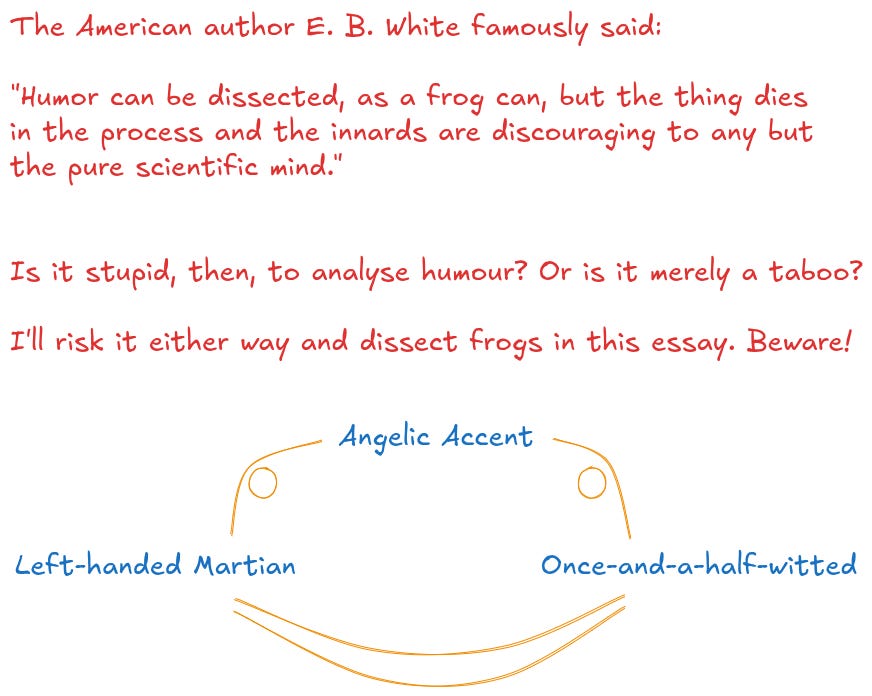
Prologue
Analysts have had their go at humor, and I have read some of this interpretative literature, but without being greatly instructed. Humor can be dissected, as a frog can, but the thing dies in the process and the innards are discouraging to any but the pure scientific mind.
That’s an ageless witticism from the admired author E. B. White, which he stated in the preface of a 1941 anthology titled A Subtreasury of American Humor. Since then, it has become customary to open with White’s Frog as a matter of caveat when analysing humour. There is something innately horrifying whenever someone explains a joke, wherein a poor thing is murdered. Take, for instance, that preceding sentence. What did you think a poor thing was referring to: the unsaid joke or the explainer’s reputation? And how do you feel now about my bringing it to your attention? But this raises a sceptical question: what is so fragile about a punchline that it allegedly cannot withstand overt examination? Or is this yet another social taboo that we have accepted without scrutiny and consideration? Either way, I shall be dissecting frogs in this essay. Hence beware the oncoming smell of death and decay. It may collide with your nose, and leave you in a state of dismay.
Angelic Accent
Edgar Allan Poe had an unusual intuition for dark humour that’s evident in his sonorous deployment of the English language. It’s as if his ears heard something different from what his eyes read. And we experience this dichotomy when reading one of his entertaining short stories called The Angel of the Odd (1844). The narrative begins with a sceptical man after dinner, who becomes frustrated by reading an implausible article in a newspaper. Suddenly, he’s confronted with the mysterious manifestation of a ghostly figure sitting across the table, who starts to speak in something resembling an extremely thick Germanish accent: “you mos pe dronk as de pig, vor zit dare and not zee me zit ere; and I zay, doo, you mos pe pigger vool as de goose, vor to dispelief vat iz print in de print. ’Tiz de troof—dat it iz—eberry vord ob it.”
I derive a peculiar sort of pleasure from parsing those phonetically spelt words, which require minor cognitive effort to fully comprehend. I also wonder why Poe chose a Germanish accent to mimic, rather than, say, French or Italian. Why did German speakers get the esteemed honour of being pilloried by Poe? It’s intriguing what happens when we try to phonetically spell out a kind of French accent using various English syllables. It turns into French as far as I can tell, remembering that Old English had absorbed innumerable French words after the Norman Conquest of 1066. Hence I’m inclined to speculate that Poe experimented first, then decided to parody Germanish phonemes, so as to help his 19th century American readers decipher the angelic accent in this story. And the story turns into a rollicking extravaganza for our sceptical protagonist, who spirals through a series of strange and suspicious accidents, but still ends up where he started in the dining room. “Thus revenged himself the Angel of the Odd,” concludes the stunned man.
More than 180 years after Poe wrote the story, it’s still socially acceptable in the Anglosphere to take the mickey out of a German accent—among many other accents, of course. The way in which pronunciation generates humour here arouses my curiosity. As a matter of self-deprecating sarcasm, I know that in my Kiwi accent there are words which sound exactly the same, e.g. or, oar, and awe. Add to that category pawn and porn. Most Australians misunderstand me when I utter slide deck, since they hear slide dick. Same thing happens when I pronounce the number six, which they interpret as the noun sex. But I console myself knowing that the Northern Irish have it far worse, given that one of them pronounces mayor, mare, mirror, and myrrh in an identical way, along with saying Howard no differently from hard, and uttering car door like corridor.
There’s a famous comedy sketch by Abbott and Costello from 1938 called “Who’s on First,” in which a question becomes its own answer with only a change of inflection. In fact, a whole series of questions undergoes such a confusing metamorphosis in the mouths of that genius duo. And fans of the film Rush Hour 3 will recall the scene about “you—Yu, me—Mi” in a similar spirit of comical confusion. A modern variation on this theme is the “Substitute Teacher” skit by Key and Peele, where common names in a classroom become confusing due to uncommon mispronunciation.
What can be a harmonious explanation for these exemplars of sound humour (pun intended)? I reckon one answer is a bottleneck in our biology. There are only so many unique noises that our mouths can make, but our brains can produce vastly more thoughts which seek vocal expression. Then our ears have a limited hearing range in terms of loudness and pitch. Therefore, it stands to reason that two different thoughts can be encoded—whether intentionally or not—into the same utterance, which then leads to a glitch in the hearer’s brain when decoding a distinct meaning out of what was heard. Thus the confusion, and its ensuing hilarity. I think that’s a plausible theory, for now, anyway. And I welcome sound alternatives.
Once-and-a-half-witted
In the assortment of extant American accents, some struggle to differentiate thorough from Thoreau. The latter is referring, of course, to the great American from the 19th century: Henry David Thoreau. Thoreau’s 1854 magnum opus, Walden, is a philosophical masterpiece of reflection and rumination. It is also very funny throughout. E. B. White said as much in the aforementioned preface of that 1941 anthology: “There is hardly a paragraph of Walden which does not seem humorous to me; … Thoreau makes me laugh the inaudible, the enduring laugh.” In the final chapter of Walden, Thoreau drops a mordant remark about his century, but it equally applies to ours:
Why level downward to our dullest perception always, and praise that as common sense? The commonest sense is the sense of men asleep, which they express by snoring. Sometimes we are inclined to class those who are once-and-a-half-witted with the half-witted, because we appreciate only a third part of their wit. Some would find fault with the morning-red, if they ever got up early enough. “They pretend,” as I hear, “that the verses of Kabir have four different senses; illusion, spirit, intellect, and the exoteric doctrine of the Vedas;” but in this part of the world it is considered a ground for complaint if a man’s writings admit of more than one interpretation. While England endeavors to cure the potato-rot, will not any endeavor to cure the brain-rot, which prevails so much more widely and fatally?
Thoreau is funny not only because his humour is witty and wise—though his words are certainly that and more—but especially because his humour speaks truths to all of humanity. As he hints by referring to Kabir, poets everywhere have understood in a primordial sense how our brains encode more than one meaning into the same utterance, if only to decode later on quite different meanings. The result does not always induce an audible laughter, as White noted, but its enduring truths have that quality of being once-and-a-half-witted. In order to amplify this point about poets a little more, I shall now exalt two beloved poets: Maya Angelou and Emily Dickinson. Their poems perennially admit of three times the meanings that my brain is able to interpret in one lifetime.
Maya Angelou was the warm and glowing star of an otherwise cold and dim ceremony to inaugurate an American president on a frosty January day in 1993. She immortalised the occasion by reciting her poem On the Pulse of Morning. “History, despite its wrenching pain, / Cannot be unlived,” she asserted, “but if faced / With courage, need not be lived again.” Two decades later, she immortalised the passing of a legendary African president in another poem, His Day is Done. “No sun outlasts its sunset,” she wrote, “But will rise again / And bring the dawn.” There’s nothing funny in these lines and poems. I quote them merely to show off that I cannot forget them, for so memorable are Angelou’s verses that no human soul who reads or hears them can ever forget them. One of her earlier poems is called In a Time (1971), which she composed as part of a lyrical collection that dealt with themes of love and loss. But when I read it today, I cannot mask a dubious smile on my face due to the undertone of political satire:
In a time of secret wooing
Today prepares tomorrow’s ruin
Left knows not what right is doing
My heart is torn asunder.
In a time of furtive sighs
Sweet hellos and sad goodbyes
Half-truths told and entire lies
My conscience echoes thunder.
In a time when kingdoms come
Joy is brief as summer’s fun
Happiness its race has run
Then pain stalks in to plunder.
Did Angelou foresee the kind of interpretation that I’m attaching to this poem now? I don’t know. What I do know is that she was finely attuned to the way history rhymes. Thus, In a Time becoming freshly relevant is not something that would have, I think, surprised her. After all, she inserted enough breathing space within these stanzas to aerate multiple meanings. My political compass usually leans leftward. So the line stressing “Left knows not what right is doing” tickles my brain. But whatever side we each orient toward, none of us can deny that “Half-truths told and entire lies” are sadly the norm in politics. Unless you’re a politician, or brainwashed by one.
I never expected that Emily Dickinson would provide me year after year after year of humorous amusement through her inimitable poetry. And that’s before I can even gratefully acknowledge all her adroit insights and truth bombs, which exploded in my cranium and expanded my imagination. She rhymed and half rhymed and em dashed in such rebellion that I’m continually inspired to overcome my lexical inhibitions. Language is freed by every page which graces her verses:
Much madness is divinest sense
To a discerning eye;
Much sense the starkest madness.
’T is the majority
In this, as all, prevails.
Assent, and you are sane;
Demur,—you’re straightway dangerous,
And handled with a chain.
I suggest deliberately mispronouncing “majority” so that it fully rhymes with “eye,” just to make this pearl of protest both fun and funny. “Mirth is the mail of anguish,” she wrote in another gem, “In which it caution arm, / Lest anybody spy the blood / And ‘You’re hurt’ exclaim!” Again, try mispronouncing “exclaim” to fully rhyme with “arm.” Now reflect on the following:
I’m nobody! Who are you?
Are you nobody, too?
Then there’s a pair of us—don’t tell!
They’d banish us, you know.
How dreary to be somebody!
How public, like a frog
To tell your name the livelong day
To an admiring bog!
I have to let that public frog live—for I cannot summon the will to murder a poor thing.
Left-handed Martian
The mirthful physicist Richard Feynman gave the 1964 Messenger Lectures at Cornell University. Grainy recordings of all seven lectures and the corresponding transcripts are available for viewing and reading online. In the fourth lecture, Feynman elucidates the concept of symmetry in physics. He uses a playful example of communicating with a Martian, and ponders the question of how can we humans explain to the Martian what we are made of? One way to establish common knowledge would be to share results of reproducible experiments. However, such results require distinguishing left from right and vice versa, wherein Feynman points out a danger:
In fact, we really can’t tell a Martian which is right and left, because if he happens to be made out of antimatter, he’d get the thing the other way, because when he does his experiment, his positrons are coming out, puts the heart on the wrong side. And so you can see that if the Martian—if you telephone the Martian, and explain how to make a man, and suppose he makes one and it works, and you explain to him also all our social conventions, and so on.
Then when we go finally to meet this man (after he tells us how to build a sufficiently good spaceship), we go to meet this man, and you walk up to him and you put out your right hand to shake hands—if he puts out his right hand, okay, but if he puts out his left hand, watch out, because the two of you will annihilate with each other!
I get a double dose of laughter from Feynman’s sci-fi joke, because I see in it also the mirror image of our polarised world. The left and the right in politics today are akin to the humans and the Martians in Feynman’s thought experiment. Cooperation requires overcoming a species barrier. All too often that barrier is too high, while the odd success in getting through to the other side soon results in mutual annihilation at the next election. This corroborates a cynical saying that we get the politicians we deserve in a democracy, which is really a warning disguised as a sarcasm. Being a firm believer in democracy, I try to reason my way to a hopeful place about the future of faltering democracies around the world—starting with the Anglosphere, specially the United States. It sure is hard to find hope in 2026! And you shall read that exclamation point as the factorial operator if you are mathematically inclined, since the challenges ahead appear to be growing out of control with each passing year, like the factorial function. Maybe the hope lies in our ability to analyse humour? If it comes down to killing each other or killing frogs—I for sure will choose the latter.
Epilogue
You might have noticed by now that—despite being a proud Non-American—I’ve discussed only American authors and dissected only American humour. It’s not because Americans have a monopoly on the art of humour—they certainly do not! It’s actually due to the coincidental timing of my posting this essay in early July, one day before Americans are due to celebrate the 250th anniversary of their Declaration of Independence. That’s a long-enough lifetime to entice natural comparisons, however naive, with the near and the far past. Many empires and dynasties lasted much longer, and some indigenous cultures have survived for many millennia to this day. As interesting as this exercise in comparative history may turn out to be, what I regard as far more illuminating is the fact that Americans continue to frame their existence as a long-running experiment. Hence, unlike all other ideologies and dogmas that are hugely overrated to justify the founding of any given nation, The American Experiment is unique in being a falsifiable hypothesis. Therein lies a democratic dynamism in how Americans renew themselves with each new generation, as one particularly promiscuous president said in his inaugural address: “There is nothing wrong with America that cannot be cured by what is right with America.”
And there is, indeed, a lot that’s depressingly wrong with America in 2026, such as the incorrect spelling of humour as “humor” and the infelicitous uttering of herbs as “erbs.” But, one thing which is still right with America is that humour has the same right as humans, since there can be no humanity without humour and no humour without humanity. Therefore, if Americans remember to find truths in humour and humour in truths, then I see no way to disprove their hypothesis.
Finally, as I did at the start, so I shall finish with an ageless witticism from an admired American. Neil Postman begins an instructive reflection on The American Experiment with the following analogy in his 1995 book The End of Education:
All children enter school as question marks and leave as periods. It is an old saying, but still useful in thinking about how schooling is normally conducted. It is also applicable, in various forms, to other situations and institutions. For example, we might say all nations begin as question marks and end as exclamation points.